
Two streams of reform under the SCHADS Award: what employers in the social, community, home care, and disability services sector need to understand
The SCHADS Award is in the middle of two significant reform processes at the Fair Work Commission. Both will reshape how employers in the disability, home care, social and community services, and crisis accommodation sectors roster, classify, and pay their workforce. Both matters are still in progress.
This article sets out what each reform covers, where it currently sits, and the practical steps employers should take now to prepare for implementation once the Commission finalises its determinations.
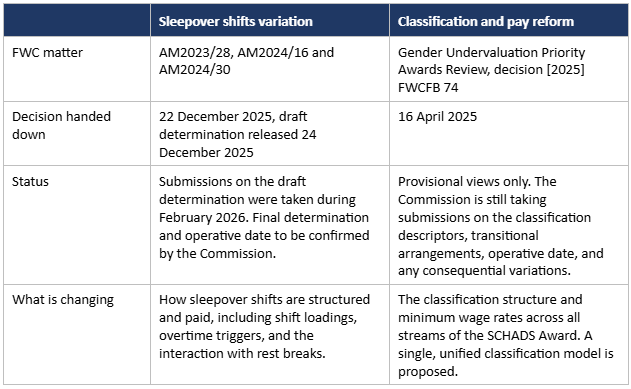
The two streams of reformat a glance
Stream one: sleepover shifts variation
The Fair Work Commission handed down its decision in the sleepover proceedings on 22 December 2025, with a draft determination released on 24 December 2025. Submissions on the draft determination were taken during February 2026. The changes will take effect from the operative date set by the Commission in its final determination.
The sleepover proceedings followed a long history of ambiguity about how work before and after a sleepover should be paid, and whether sleepovers count as part of a shift or a break between shifts. The Federal Court's decision in Jats Joint Pty Ltd v Fair Work Ombudsman [2025] FCA 743, upheld on appeal by the Full Federal Court in March 2026 ([2026] FCAFC 25), held that a sleepover is a separate period that does not form part of a shift. The FWC's variation is designed to resolve the remaining ambiguity in the Award itself.
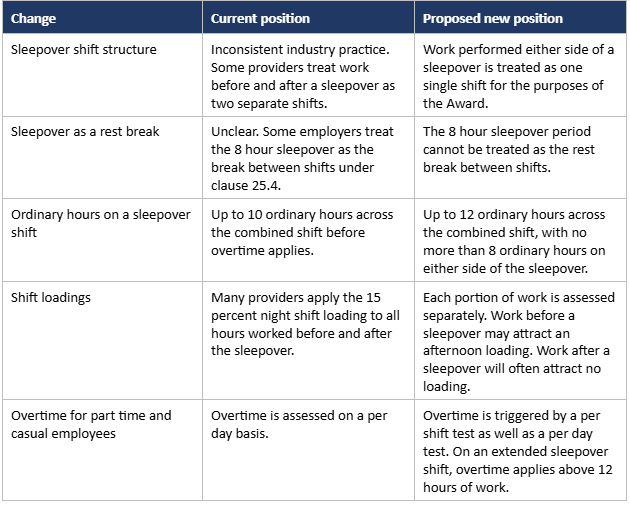
What is proposed to change
How the extended12 hour sleepover shift works
The extended sleepover shift gives employers more flexibility before overtime is triggered. The structure is constrained. No more than 8 ordinary hours can be worked on either side of the sleepover. This prevents work being loaded heavily on one side of the sleepover to avoid overtime.
Examples of compliant extended sleepover structures include 8 hours of work before the sleepover and 4 hours after, or 6 hours of work on each side. Overtime applies above 12 total hours, or above 8 hours on either side of the sleepover.
The shift loading change: a potential cost reduction
Under current practice, many providers apply the 15 percent night shift loading to all hours worked before and after a sleepover on the basis that the combined period is one continuous shift running past midnight. The variation, consistent with the Federal Court decision in Jats Joint, treats each portion of work separately for shift loading purposes.
The likely commercial effect is that work immediately before a sleepover may attract an afternoon shift loading depending on timing, and work immediately after a sleepover will often attract no shift loading. For providers who have been applying night shift loadings across the entire sleepover shift, this may reduce labour cost. For providers who have been correctly applying separate loadings, the change will formalise existing practice.
Stream two: classification and pay reform
Separately, the Fair Work Commission has handed down its initial decision in the Gender Undervaluation Priority Awards Review, [2025] FWCFB 74, on 16 April 2025. The decision found that the existing minimum wages for social and community services employees, crisis accommodation employees, and home care employees under the SCHADS Award do not properly reflect the value of the work, in part due to historical gender-based undervaluation.
The Commission's provisional views represent a significant restructuring of the Award. This is not a minor pay increase. It is a proposed replacement of the current classification structure across Schedules B, C, D, E, and F with a single unified structure, new benchmark rates, and the revocation of the Equal Remuneration Order.
What is proposed
A single, unified classification structure across all streams of the Award, replacing the current Schedules B to F.
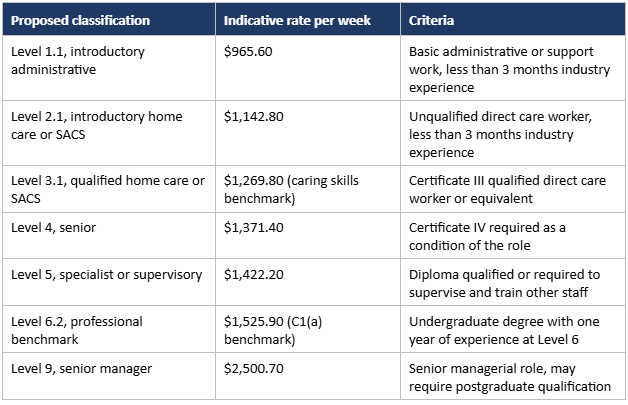
A caring skills benchmark of $1,269.80 per week at Level 3.1 for Certificate III qualified direct care workers. This aligns with the current Equal Remuneration Order rate for a SACS employee Level 2, pay point 1.
A C1(a) benchmark of $1,525.90 per week for degree qualified employees at Level 6.2. This is derived from the manufacturingindustryC1(a) benchmark.
Removal of annual pay increments within levels. Progression is driven by qualification and experience milestones rather than automatic yearly steps.
Recognition of lived experience as equivalent to formal training at relevant classification levels, a feature the Commission identified as particularly relevant to SACS work.
Revocation of the Equal Remuneration Order once the new rates are implemented, on the basis that the new rates themselves address the gender-based undervaluation the ERO was designed to remedy.
Removal of family day care scheme work (current Schedule D) from the SCHADS Award, with coverage moving to the Children's Services Award 2010.
Indicative rates under the proposed structure
The table below summarises selected levels from the proposed classification structure. Rates are taken from the Commission's provisional views as at April 2025 and do not reflect any subsequent Annual Wage Review adjustments. They are provisional and subject to change.
Status of this reform
The classification reform is at provisional views stage. The Commission has expressly asked interested parties to submit on four questions: whether the classification descriptors are sufficient to classify all employees; what transitional arrangements should apply so no employee's wage rate is reduced; what the operative date should be, including any phasing arrangements, having regard to the funding constraints on SCHADS employers; and what other provisions of the Award might need to be modified. Submissions from employer groups, unions, and government funding bodies are still being received.
The operative date has not been set. Phasing arrangements have not been determined. The final classification structure may differ from the provisional structure. Employers should monitor the proceedings closely but should not implement changes until the Commission issues final determinations.
What employers should do now
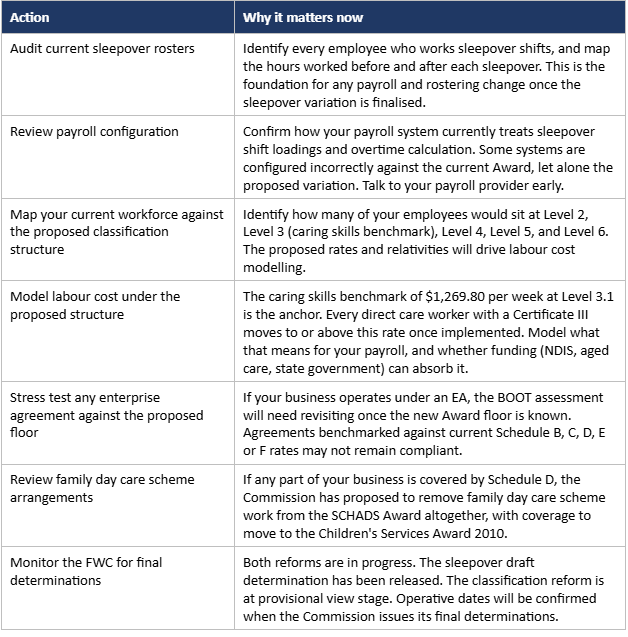
Both reforms are in progress. The sleepover variation is closer to implementation than the classification reform. However, the scale of the classification reform makes early preparation essential. The checklist below sets out the practical steps SCHADS employers should take now.
Why this matters for funding conversations
For NDIS providers, aged care providers, and state-funded social service providers, the classification reform will materially affect labour cost. The caring skills benchmark of $1,269.80 per week will become the floor for Certificate III qualified direct care workers. For providers whose current rosters are built on lower SACS or home care rates, the uplift is significant.
Providers should begin modelling the combined impact of the caring skills benchmark, the indicative rates at Levels 4, 5, and 6, and the removal of the ERO once the new rates are implemented. Funding conversations with NDIS, aged care, and state government commissioning bodies should begin early. The Commission has expressly acknowledged funding constraints as a relevant consideration in setting the operative date, which signals that phased implementation is likely.
How IndustrialHR can help
We work with disability, home care, social and community services, and crisis accommodation providers across Australia on payroll configuration, award interpretation, classification reviews, roster design, enterprise agreement strategy, and workforce cost modelling. If you are unsure how the sleepover variation or the classification reform will affect your business, we can review your rosters, your payroll configuration, your classification structure, and your employment documentation, and build a plan for when each reform is finalised.
Call us on 0481 100 416 or email [email protected] to arrange a time to talk.